What the Romans had in their luggage
How Italy came to the RhineChapter 1
Every story needs a beginning. Ours does not begin in 1978, nor in Venice. It begins in the neighbourhood, where two rivers meet. The first guests from the south wore no aprons there, but helmets. And they had things in their luggage that still end up on our plates and in our glasses today.
Where does Koblenz get its name?
From the Romans. Around 9 BC they built a fort where the Moselle and the Rhine flow together. They called it “Castellum apud Confluentes”, the fort by the confluence. That became Koblenz. The Romans simply liked to call things what they looked like.
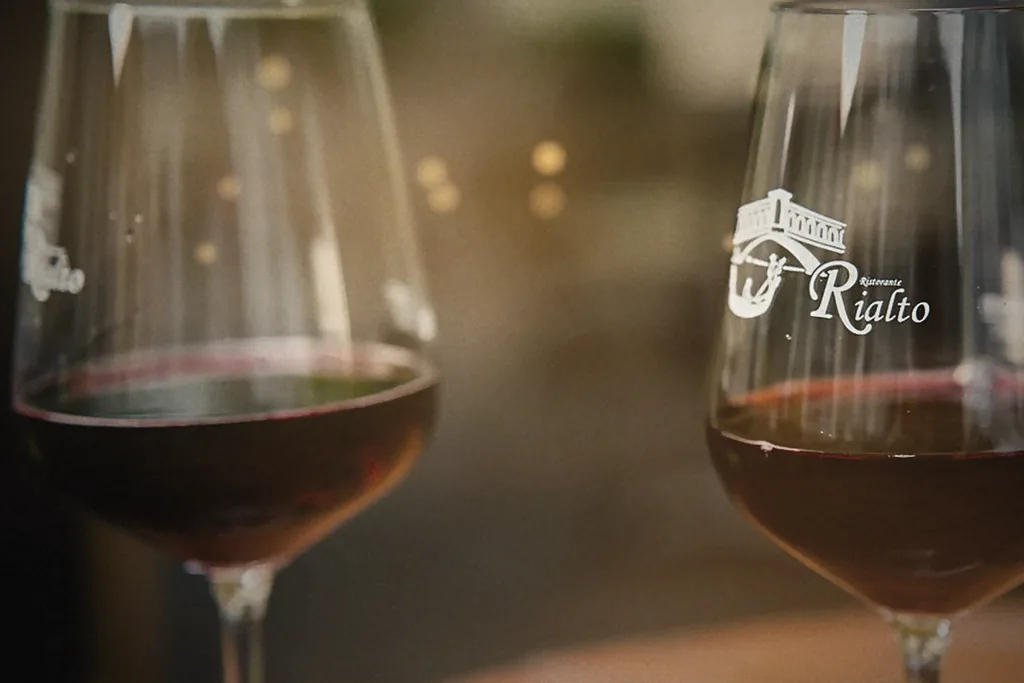
From AD 49 a wooden bridge led across the Rhine to Ehrenbreitstein. How old it is, the growth rings of its piles reveal. That is the first bridge in this story. The second stands in Venice: the Rialto Bridge over the Grand Canal, with shops on it and the Rialto market right next door. It is in our logo. Two rivers, two bridges: this whole story hangs on them.
Who brought the chestnut to the Rhine?
Probably the Romans, and together with wine. The sweet chestnut comes from the Mediterranean. North of the Alps it most likely spread along with winegrowing, and for a practical reason. Its wood withstands rain and weather for a very long time. That is why, for centuries, it was used to make the stakes for the vineyards. So the chestnut quite literally stood by the wine.
Experts explicitly name the Middle Rhine and the Moselle valley as landscapes shaped by the tree. On the Moselle there is even a village called Kesten. In the Palatinate they say “Keschde”. A tree from the south that has earned its own dialect word: you can hardly arrive better than that.
What does a ship that never sailed have to tell us?
In the Rheinisches Landesmuseum in Trier stands a ship made of stone, loaded with wine barrels. It once crowned the tomb of a wealthy wine merchant and was made around AD 220. A copy stands in Neumagen-Dhron on the Moselle. Whether it shows a cargo ship or a warship, experts still argue to this day. The only thing they all agree on is the cargo. A wine merchant who refused to be left high and dry even on his own grave: at the Rialto he would have been given a table at once.
That wine really was pressed on the Moselle back then, the soil itself shows. In Piesport, in 1985, a Roman wine press was excavated, with more than ten rooms and seven basins. It is considered the largest of its kind north of the Alps.
Who wrote a love poem to the Moselle?
A man from Bordeaux. Around 371 the Roman poet Ausonius, then tutor at the imperial court in Trier, wrote the “Mosella”. In it he describes the journey from Bingen via Neumagen to Trier and the slopes full of vines. The poem is one of the most important sources on ancient wine on the Moselle. Today his verses are written on house walls in Moselle villages. There are poets you visit in a museum. And there are poets you walk past on your way to the baker’s.
What comes to the table at the Rialto in autumn?
Whatever the season offers. First came the chanterelles, then the porcini. Now the evenings call for dishes that are allowed to braise for a long time and warm you from the inside. In November, for example, there are gnocchi with a wild boar ragout. Wild boar, incidentally, may be hunted all year round in Rhineland-Palatinate. Only the sows are spared while they still have striped, dependent piglets.
You cannot rush a braise. It needs time, like a good conversation. You put the pot on, leave it in peace and only look in now and then. In the end, what belongs together has found each other.
What is on right now is on the weekly menu. You are welcome to book a table personally by phone on 0261 60329.
What became of the wine once the Romans were long gone, and why a prince-elector meddled in the grape varieties, is told in the second chapter.
AddressRistorante Rialto, Löhrstraße 77, 56179 Vallendar
Opening hoursTuesday to Saturday 11:30–14:15 and 17:30–22:00, closed Sunday and Monday
Phone0261 60329, we are happy to book tables by phone
Feeling hungry?
That is catching here. The whole menu is one click away, a table one phone call.